العربية
 中文 (中国)
 فارسی
فارسی Türkçe
 Русский

For international buyers, blenders, and procurement managers in the petrochemical sector, securing consistent quality is vital, especially when it comes to the heavy-duty workhorse of the Group I family: SN500. As a leading gateway to world-class refineries, Petrobon understands that knowing the exact technical parameters of your raw materials is critical for successful and profitable lubricant formulation.
In this guide, we break down the standard Certificate of Analysis (COA) specifications for Base Oil SN500, explore its primary industrial applications, and explain why sourcing export grades from Iran provides a massive strategic and economic advantage for global buyers.
What Makes SN500 Unique?
Solvent Neutral 500 (SN500) is a heavier, high-viscosity Group I base oil. Because it undergoes extensive solvent extraction and dewaxing, it boasts a strong molecular structure capable of providing a thick, protective lubricating film under high temperatures and heavy mechanical loads. It serves as the foundational base for heavy-duty applications where lighter oils would simply burn off or fail to separate moving metal parts.
To understand how Group I oils are manufactured and categorized, read our comprehensive guide: What Is Base Oil and How Is It Used in Lubricant Manufacturing?
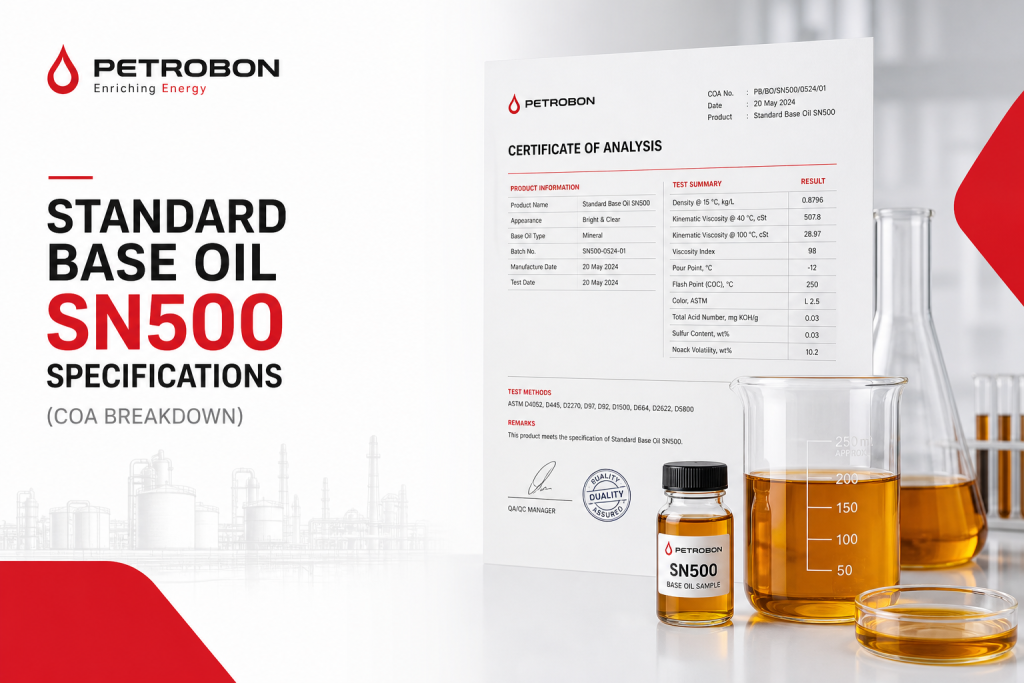
Standard Base Oil SN500 Specifications (COA Breakdown)
When procuring SN500 in bulk, engineers and blenders must verify the technical parameters on the COA. While exact numbers can vary slightly depending on the refinery and whether the product is virgin or recycled, standard premium SN500 typically falls within these ranges:
- Kinematic Viscosity @ 100°C:5 to 11.5 cSt (Centistokes). This defines its resistance to flow at operating temperatures.
- Kinematic Viscosity @ 40°C: Typically between 95 and 115 cSt.
- Viscosity Index (VI): Minimum 90. A higher VI ensures the oil maintains its stability across fluctuating temperatures.
- Flash Point: Minimum 230°C to 240°C. A high flash point is crucial for safety and performance in high-heat environments.
- Pour Point: Usually around -3°C to -6°C, dictating the lowest temperature at which it will flow before freezing.
- Color: Typically 1.5 to 2.5 (ASTM D1500) for virgin grades, indicating high refinement and low impurities.
Common Industrial and Automotive Applications
Because of its robust viscosity and high flash point, SN500 is indispensable in heavy machinery and demanding automotive environments. It is the primary base stock used in the formulation of heavy-duty diesel engine oils, marine lubricants, industrial gear oils, and compressor fluids. Furthermore, blenders frequently use it as a thickening agent to increase the final viscosity of multigrade engine oils.
If you are comparing it with lighter grades for your formula, see our detailed breakdown: Base Oil SN500 vs SN150: Choosing the Right Viscosity Grade.
Why Source SN500 from Iran?
Iran stands out as one of the most strategic hubs for Group I base oil exports. With access to vast crude oil reserves and well-established, highly advanced refineries (such as Sepahan, Behran, and Iranol), Iran produces thousands of metric tons of premium SN500 annually. For international buyers, this translates to highly competitive pricing without compromising on international ASTM standards. Additionally, the country boasts robust export infrastructure, allowing for flexible shipping in steel drums, flexitanks, or bulk vessels.
Virgin vs. Recycled SN500: Which Do You Need?
Iranian refineries and downstream petrochemical plants export both premium virgin SN500 and high-quality re-refined (recycled) SN500. While virgin oil is ideal for premium, high-stress automotive applications, modern re-refined SN500 offers a highly cost-effective alternative for general industrial lubricants and agricultural machinery.
To understand the economic and technical differences, read: Virgin vs Recycled Base Oil: Quality, Cost and Application Differences.
Secure Your SN500 Supply with Petrobon
Navigating international petrochemical procurement requires a reliable partner. Petrobon facilitates smooth, secure, and quality-assured exports of SN500 from top Iranian refineries directly to your facilities. We handle the logistics, ensure strict COA compliance, and provide transparent pricing for your bulk orders.
Frequently Asked Questions (FAQ)
What does the “500” in SN500 stand for?
It refers to its approximate kinematic viscosity measured in Saybolt Universal Seconds (SUS) at a temperature of 100°F. “SN” stands for Solvent Neutral, indicating the refining process.
What packaging options are available for SN500 exports from Iran?
Depending on your order volume and destination, SN500 can be securely exported in new or reconditioned 208-liter steel drums, flexitanks, ISO tanks, or bulk vessels.