العربية
 中文 (中国)
 فارسی
فارسی Türkçe
 Русский

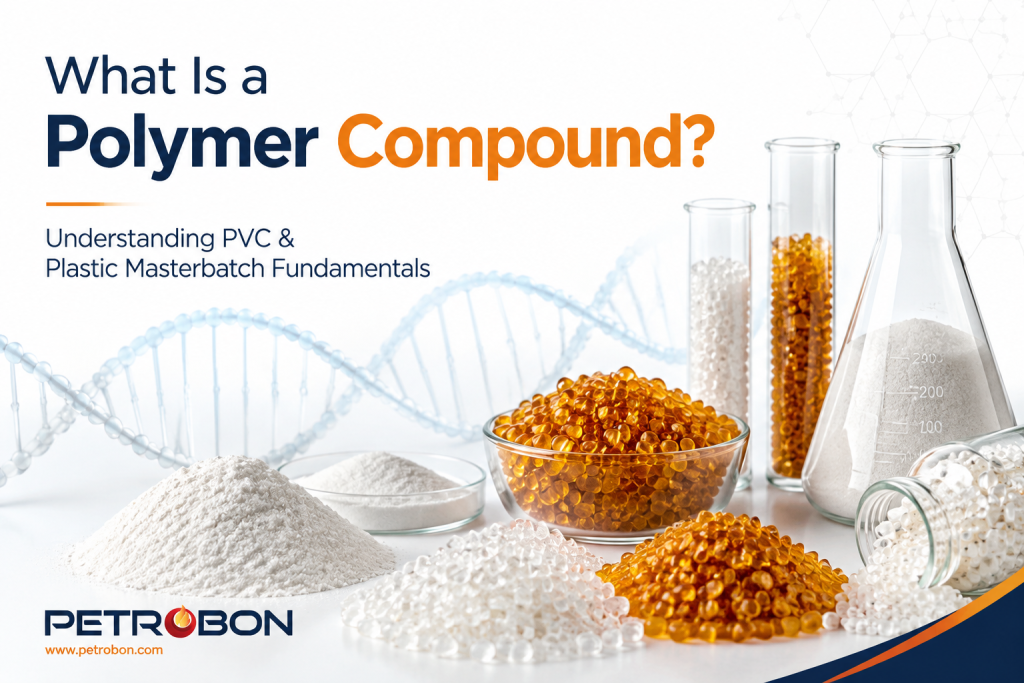
For procurement managers and manufacturing converters, selecting the right raw material is the most consequential step in production. Many buyers are highly familiar with standard polyethylene (PE) and polypropylene (PP) base resins. However, as product requirements become more stringent, standard resins often fall short of meeting specific mechanical, thermal, or aesthetic demands. This is where understanding exactly what is a polymer compound becomes crucial. In simple terms, a compound is not a raw, unaltered resin; rather, it is a resin that has already been precisely modified with additives, fillers, or reinforcements tailored for a specific application.
As a leading international petrochemical and polypropylene compound supplier, Petrobon understands that navigating these advanced materials can be complex for first-time buyers. This foundational guide will explain what compounds are, how they fundamentally differ from standard homopolymer resins, and how to source the exact compound grade your manufacturing line requires.
Compound vs. Base Resin — The Core Difference
To understand the value of a polymer compound, it is helpful to look at the starting point: the base resin. A base resin, such as a standard PP homopolymer, is a pure, unmodified plastic produced directly by a petrochemical plant. It is the blank canvas of the plastics industry. While a base resin can be melted and molded, it relies entirely on its natural polymer structure for its properties.
A compound, on the other hand, is a ready-to-process formulation. It takes that base resin and mechanically blends it with various secondary ingredients to alter and enhance its physical characteristics. By the time a converter receives a shipment of a compound grade, all the complex formulation work has already been completed.
For the international buyer, the business benefit of purchasing a compound is clear. It eliminates the need for in-house mixing, reduces the processing steps on the factory floor, and eliminates the need to source and store individual additives. Most importantly, it guarantees strict, batch-to-batch consistency. Converters can simply feed the compounded pellets directly into their injection molding or extrusion machines, knowing the material is already optimized for their end product.
How Compounds Are Made
The creation of a polymer compound is a highly precise thermomechanical process. It typically takes place in a specialized machine called a twin-screw extruder. The base resin (often in powder or pellet form) is fed into the extruder alongside the precise ratio of desired additives. Inside the barrel of the extruder, intense heat and mechanical shearing forces melt the resin and disperse the additives evenly throughout the polymer matrix. The thoroughly mixed molten plastic is then pushed through a die, cooled, and cut into new, ready-to-use pellets.
For buyers interested in the deep technical mechanics of this process, including the specific temperature controls and extrusion technologies utilized, we have prepared a dedicated technical overview. You can explore the exact manufacturing steps in our guide on How Polypropylene Compounds Are Manufactured: From Homopolymer to Finished Compound.
Common Types of Additives and Modifications in Compounds
The versatility of a PP compound or PE compound lies in the vast array of additives that can be integrated into the base resin matrix. Depending on the final industrial requirement, compounders may introduce several different modifications:
- Fillers (Talc, Calcium Carbonate): These are commonly added to increase the stiffness and dimensional stability of the plastic, preventing warping in large molded parts (like automotive dashboards). They also serve to reduce the overall cost by replacing a percentage of the more expensive base polymer.
- Impact Modifiers: Standard base resins can become brittle, especially at low temperatures. Elastomers or rubbers are blended into the compound to dramatically increase the material’s toughness and impact resistance, making it suitable for heavy-duty containers or automotive bumpers.
- UV Stabilizers: If the final plastic product will be used outdoors (such as patio furniture or agricultural piping), UV stabilizers are added to the compound to prevent the sun’s ultraviolet rays from degrading and cracking the plastic over time.
- Colorants (Masterbatches): Rather than blending color at the injection molding machine, buyers can order a pre-colored compound, ensuring perfectly uniform pigment distribution across thousands of production cycles.
- Flame Retardants: Essential for electrical housings and construction materials, these chemical additives prevent the plastic from catching fire or slow down the spread of flames to meet strict safety regulations.
Compound Grades Petrobon Supplies
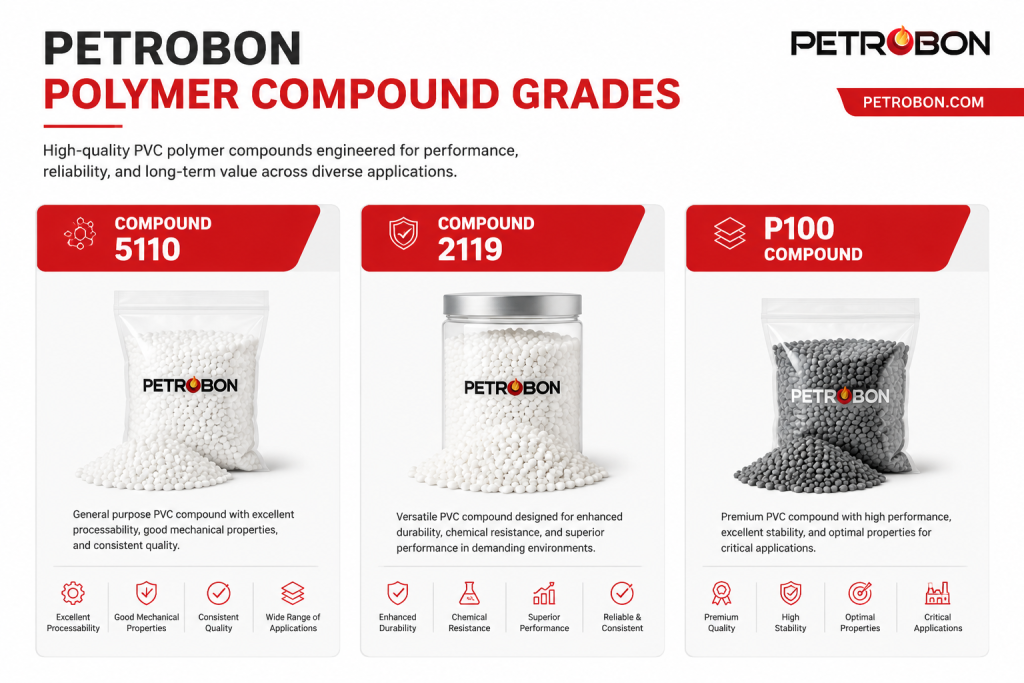
As a reliable international distributor, Petrobon focuses on supplying highly consistent, industry-standard compound grades that serve the automotive, piping, and specialized manufacturing sectors. Below is a brief introduction to the primary grades we supply in bulk.
Grade Designation | Primary Application & Focus |
Compound 5110 | A specialized grade engineered for durability and specific extrusion profiles. Learn more about its technical parameters in Compound Grade 5110: Specifications and Applications. |
Compound 2119 | A versatile compound frequently utilized in demanding manufacturing environments. Discover its full material properties in Compound Grade 2119: Specifications and Applications. |
P100 Compound | A high-performance pipe-grade material designed for critical infrastructure and pressurized fluid transport. Read the complete breakdown in P100 Compound Explained: Composition and Industrial Uses. |
Compound vs. Homopolymer — Why Buyers Choose One or the Other
The choice between a compound vs homopolymer ultimately comes down to a converter’s internal capabilities and their specific end-product requirements.
A standard homopolymer is ideal for converters who have the equipment, the chemical engineering expertise, and the time to formulate their own additive recipes in-house. It provides maximum flexibility and a lower initial raw material cost per ton.
Conversely, buyers choose a pre-formulated compound when convenience, strict quality control, and processing speed are the priorities. Using a compound acts as a drop-in solution that drastically reduces the risk of in-house formulation errors, uneven color distribution, or weak spots in the molded part. To fully evaluate the financial and operational trade-offs between these two distinct procurement paths, read our comprehensive analysis: Compound vs Homopolymer: Why Buyers Choose Compounded Polypropylene.
How to Source Compounds from Iran
For international buyers looking to balance premium quality with highly competitive pricing, sourcing polymer compound Iran offers a significant strategic advantage. Iran’s vast petrochemical infrastructure produces some of the most reliable compounded resins in the region.
Petrobon supplies bulk compound grades directly from top-tier Iranian producers, including the highly respected compounding lines of Shazand Petrochemical. We manage the entire cross-border procurement process, ensuring that every shipment is fully backed by official Certificates of Analysis (COA) and complete export documentation to guarantee smooth customs clearance at your destination port.
Frequently Asked Questions (FAQ)
Is a compound more expensive than a base resin?
On a strict per-ton basis, a polymer compound typically costs more than a standard base resin because the formulation work, additive integration, and secondary extrusion processes have already been completed by the manufacturer. However, for most converters, this initial premium is highly cost-effective, as it offsets the need for expensive in-house blending equipment, reduces processing time, and minimizes material waste.
Can I request a custom compound formulation?
While our core strength lies in supplying established, high-volume industrial grades, the Petrobon technical sales team can expertly advise you on matching your precise manufacturing requirements to an existing, proven compound grade in our catalog, ensuring rapid availability and verified performance.
What’s the difference between Compound 5110 and Compound 2119?
While both are highly specialized materials, they contain different additive packages tailored for distinct melt flow rates, impact resistances, and end-use applications (such as differing pipe or injection molding specs). To understand which is the exact fit for your production line, please review our comparative guide: Choosing Between Compound Grades 5110 and 2119 for Your Application.